
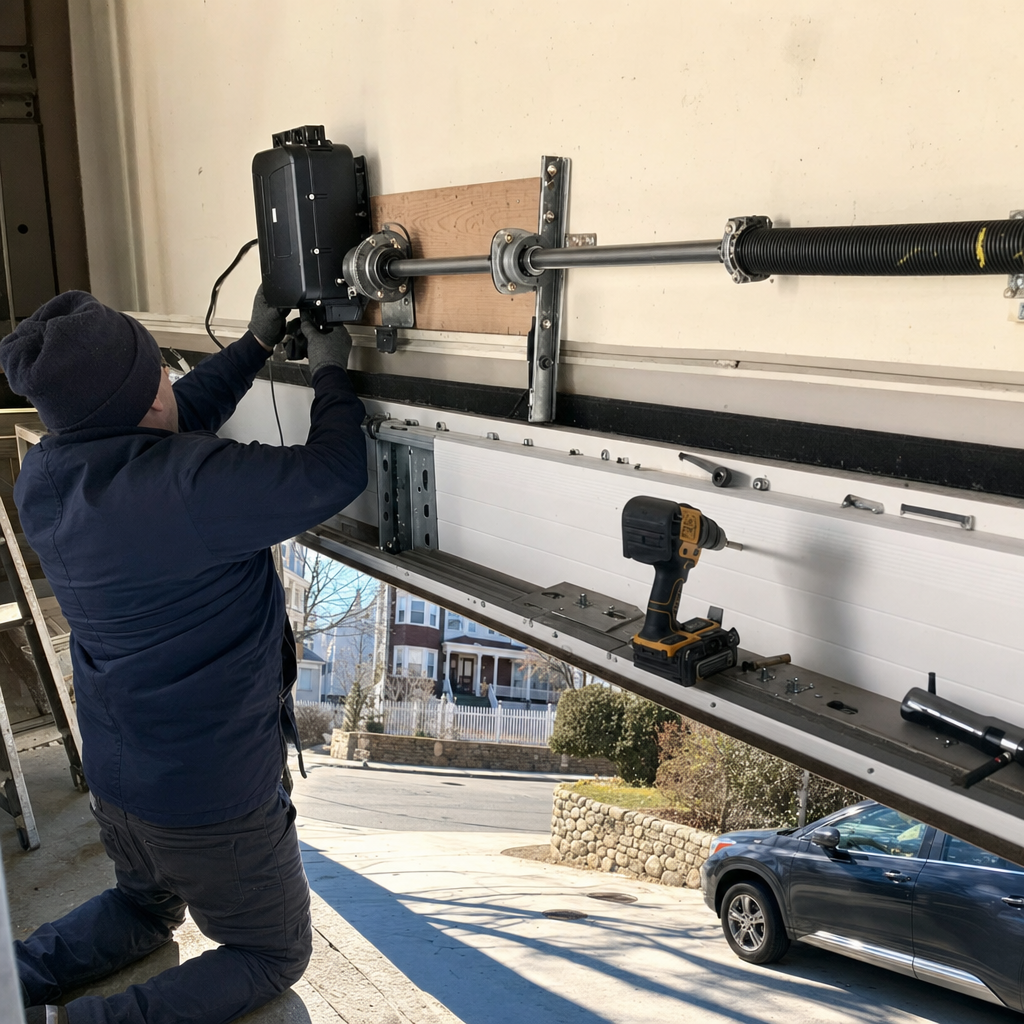
New Garage Door Installation Cost in Massachusetts: What You’ll Actually Pay and What Lasts
Garage Door Installation in Massachusetts typically runs $700–$2,200 installed, with most homeowners in the state landing between $1,100 and $1,600 for a quality steel door with standard hardware and professional fitting. Call (833) 754-8144 for a free, exact quote measured to your opening — we serve Worcester, Cape Cod, and everywhere between.
A $900 steel door installed on a Cape Cod home two blocks from the ocean will look weathered in 4 years and need panel replacement in 7. A $1,400 galvanized steel door with a factory-baked finish might outlast the house. The new door cost conversation in Massachusetts starts with environment, not sticker price. We’ve learned this the hard way over eight years of installing and later replacing doors that were technically “correct” but fundamentally wrong for where they lived.
Why Massachusetts Climate Zones Should Drive Your Door Choice
Massachusetts isn’t one market for garage doors — it’s three distinct corrosion and stress environments that most national cost guides completely ignore.
Coastal salt exposure from Newburyport to Provincetown eats standard steel alive. The salt spray carried on southeast winds deposits chloride ions that accelerate rust at panel seams and bottom edges where water pools. We’ve replaced 6-year-old doors in Scituate and Marshfield that looked 15. Standard 24-gauge steel with a basic paint finish simply isn’t designed for this.
Inland freeze-thaw cycling through Worcester County and the Pioneer Valley puts different stress on materials. Water infiltrates minor dents or scratches, expands when temperatures drop below 20°F (common January nights in Massachusetts), and creates micro-cracks that propagate through paint and protective coatings. Fiberglass doors handle this well but become brittle below 10°F — a real concern in the hill towns.
Urban heat island effect in Boston, Cambridge, and Springfield accelerates UV degradation and thermal expansion of vinyl components. We’ve seen vinyl trim warp and seal failure on south-facing installations in Dorchester and Roxbury after just 3 summers.
Here’s what actually holds up where:
- Coastal Massachusetts (within 2 miles of salt water): Galvanized steel with baked-on polyester or fluoropolymer finish, or aluminum-frame with composite panels. Avoid standard steel and bare wood.
- Inland Zone 5 climate (Worcester, Springfield, Pittsfield corridor): Insulated steel with thermal break, or high-quality fiberglass with UV-stable gel coat. Minimum R-12 for attached garages.
- Urban heat island (Boston metro, Springfield core): Light-color steel with reflective finish, or aluminum. Dark colors absorb too much radiant heat and accelerate hardware fatigue.
Installed Cost Breakdown: Where Every Dollar Goes
When Larry Peterson measures your opening and quotes your job, here’s what you’re actually paying for. We don’t bury costs or surprise you with “oh, we also need to…” on installation day. Larry leads every job, so the person who measured is the person who installs — no telephone game between sales and crew.
| Line Item | Cost Range (MA) |
|---|---|
| Door (material only, single 16×7) | $400–$1,400 |
| Track system & hardware | $120–$280 |
| Spring system (torsion, standard lift) | $180–$340 |
| Opener (if new or replacement) | $250–$550 |
| Removal & disposal of old door | $75–$150 |
| Permit (where required — see below) | $50–$150 |
| Professional installation labor | $300–$600 |
| Total Installed | $700–$2,200 |
Permits matter in Massachusetts more than most homeowners expect. Worcester requires permits for any door replacement involving structural modification to the opening. Boston’s ISD requires permits for opener installation in shared-wall garages (common in triple-deckers and row houses). Springfield and Lowell have similar triggers. We handle permit filing as part of our installation service — Larry knows which municipalities ask and which don’t, because he’s pulled permits in most of them personally.
Disposal isn’t glamorous but it’s non-trivial. A standard steel door weighs 150–200 pounds. Hauling it yourself means a trip to a Massachusetts waste facility that accepts construction debris, plus the physical reality of coiling old torsion springs safely. We include disposal because we’ve seen too many homeowners leave old doors leaning against the house for months.
Brand Value Tiers: What Larry Actually Installs and Why
We work on all major brands — LiftMaster, Chamberlain, Genie, Clopay, Amarr, Wayne Dalton, Craftsman, Raynor — but when it comes to new installation, we steer Massachusetts homeowners toward specific models based on what we’ve watched survive (or fail) in local conditions.
Clopay Canyon Ridge runs $1,600–$2,200 installed for a 16×7. The polyurethane core and composite overlay handle coastal humidity without the maintenance burden of real wood. In Massachusetts, the premium pays back on Cape Cod and the Islands where wood doors need restaining every 18 months. We’ve installed Canyon Ridge doors in Falmouth and Hyannis that still look new at year 5.
Amarr Classica lands at $1,200–$1,700 installed. The stamped steel design mimics carriage-house styling at lower weight and cost. The catch: it’s still steel, so coastal installations need the upgraded finish package. For inland Zone 5 homes in Shrewsbury or Holden, it’s the sweet spot of aesthetics and durability. Larry’s installed more Classica doors in Worcester County than any other decorative style.
Wayne Dalton 9100 series comes in at $900–$1,300 installed. It’s a workhorse steel door with decent insulation options. Where it fits: rental properties, detached garages in lower-stress inland locations, and homeowners who need functional over fancy. We’ve seen premature hardware wear in high-cycle applications (home businesses, multiple daily openings), but for standard residential use it’s honest value.
Your brand, our expertise — we’ve diagnosed and repaired every one of these after installation by other companies, so we know their failure modes before we quote them.
Insulation R-Value: The Cost Massachusetts Homeowners Recover Fast
Most of Massachusetts sits in IECC Climate Zone 5. If your garage shares a wall with living space — common in colonials, capes, and virtually all new construction — the garage door is essentially an exterior wall that moves. An uninsulated or poorly insulated door becomes a thermal bridge that your heating system works overtime to overcome.
The math is straightforward and we’ve verified it with customers who tracked their bills:
- R-6 (basic polystyrene): Standard on low-cost doors. Better than nothing. In a Zone 5 Massachusetts winter, heat loss through a 16×7 R-6 door costs roughly $180–$240 in excess heating annually for an attached garage.
- R-12 (polyurethane core, 1-3/8″ thickness): The practical minimum for attached garages in Massachusetts. Annual excess heat loss drops to $80–$120. The $200–$350 upfront cost premium over R-6 typically pays back in 2–3 heating seasons.
- R-16 (2″ thick polyurethane, Clopay Intellicore or equivalent): Best for heated workshops, home gyms, or garages under bedrooms where thermal comfort matters. Payback extends to 4–5 years, but comfort improvement is immediate and measurable.
We’ve had customers in Grafton and Westborough call back specifically to thank us for pushing them toward R-12 minimum — their January gas bills dropped noticeably. One homeowner in Auburn tracked it: $187 savings year one on a door that cost $280 more than the R-6 alternative. That’s not marketing; that’s Massachusetts winter doing the math for you.
Owner-Operator Accountability: One Call, One Expert
Here’s where Sequoia Garage Door Repair differs from the dispatch-model competitors you’ll find in Massachusetts. Larry Peterson measures your opening, selects your door from the manufacturer, and installs it himself. If the door arrives with a manufacturing defect — it happens, even with good brands — Larry’s the one standing there who can spot it immediately and make the call. No finger-pointing between sales, warehouse, and installation crew. No “we’ll have to schedule a return visit with a different technician.”
Larry grew up in Worcester, not far from Elm Park, and still lives within a twenty-minute drive of most regular customers. He learned the mechanical side through Quinsigamond Community College’s Building Trades program — hands-on instruction, not YouTube — and got into garage doors after helping his father-in-law replace a busted opener on a January Saturday. Eight years later, he’s the one who shows up, not a subcontractor. His daughter still jokes that he talks about spring tension at dinner.
That matters for installation specifically because garage door fitting isn’t plug-and-play. Massachusetts housing stock spans 150 years of construction standards. A 1920s Worcester triple-decker has an opening that’s “16 feet” the way a 2010 suburban garage has “16 feet” — but they’re not the same. Larry’s measured enough of them to know when to order a custom width, when to rebuild trim, when an older header needs reinforcement before a heavier insulated door goes up. Tell me what it’s doing, and I’ll tell you what it needs — no guesswork, no runaround.
480 neighbors agree: our 4.8-star average across verified reviews reflects what happens when the same expert handles your job start to finish.
FAQs
Most homeowners pay between $1,100 and $1,600 for a standard single 16×7 insulated steel door, fully installed with hardware and disposal of the old door — see How Much Does Garage Door Installation Cost? (2026 Price Guide) — Massachusetts, MA for full pricing breakdowns. Premium materials like Clopay Canyon Ridge composite or oversized custom doors can push the total toward $2,200. Call (833) 754-8144 for an exact quote measured to your opening — estimates are free.
Repair makes sense when the door itself is structurally sound and the issue is isolated to springs, cables, or an opener — most repairs we handle run $150–$600. Replace when panels are rusted through, the door is uninsulated and attached to heated living space, or repair costs exceed 60% of replacement. We’ve had Massachusetts customers spend $800 repairing a 20-year-old uninsulated door, then call us back two winters later for replacement anyway; Larry’s happy to walk you through the honest math on your specific door.
A standard replacement on an existing opening takes 3–5 hours for one experienced technician — Larry typically completes a straightforward 16×7 steel door installation in a morning. New construction or situations requiring header reinforcement, electrical work for an opener, or custom sizing can extend to a full day. We don’t rush; a properly balanced door with correct spring tension and safety sensor alignment is worth the extra 30 minutes.
For coastal salt exposure, Clopay’s composite-overlay Canyon Ridge or aluminum-frame models outperform standard steel. For inland Zone 5 freeze-thaw, Amarr’s insulated steel with thermal break or quality fiberglass handles the stress. Wayne Dalton’s 9100 series offers honest value for detached garages in lower-stress locations. The Best Garage Door Installation in Massachusetts, MA depends on your specific microclimate and how your garage relates to your home — we match the door to the conditions, not the commission.
Get Your Free Estimate: Exact Pricing for Your Massachusetts Home
Ready to stop guessing and know your real number? Call (833) 754-8144 for a free, no-obligation estimate. Larry Peterson will measure your opening, assess your home’s specific conditions, and quote you a door that actually belongs in your Massachusetts environment — not just one that looks good in a catalog. Emergency Garage Door Installation in Massachusetts, MA with same-day appointments available for urgent situations, backed by the accountability that comes from owner-operated, hands-on service.
Written by Larry Peterson, Owner & Lead Technician at Sequoia Garage Door Repair Massachusetts, serving Massachusetts, MA.