
Last updated July 10, 2026
Seasonal Garage Door Care for Boston: Year-Round Homeowner’s Guide
Here’s what most Boston homeowners get wrong: the spring that snaps in a January cold snap didn’t fail because of the temperature. It failed because eleven months of grinding, unlubricated cycles and a July heat wave that over-tensioned the coils went completely unaddressed. In our eight years serving Boston, we’ve replaced hundreds of springs that could have lasted another three to five seasons with basic attention at the right moments. This guide breaks that chain. You’ll learn the specific maintenance tasks that matter for each of Boston’s four distinct stress regimes — and the two critical fall tasks that determine whether your door survives winter intact.
Quick Answer
Seasonal garage door care in Boston means four targeted maintenance windows: fall seal and cable inspection before freeze-thaw cycles begin, winter lubrication and manual operation checks during cold months, spring post-winter hardware inspection after the damage is done, and summer humidity and heat-tension monitoring for wood doors and spring calibration. A single 20-minute between-seasons check catches roughly 80% of developing problems before they become emergency repairs.
Table of Contents
- Why Boston’s Climate Wears Garage Doors Differently
- Fall Maintenance: The Two Tasks That Determine Your Winter
- Winter Survival: Frozen Seals, Stuck Doors, and What Never to Force
- Spring Recovery: Inspecting What the Freeze-Thaw Cycle Damaged
- Summer Heat and Humidity: The Hidden Stress Season
- The 20-Minute Between-Seasons Check That Prevents 80% of Emergency Calls
- Common Mistakes to Avoid
- When to Call a Professional
- Frequently Asked Questions
- The Bottom Line
Why Boston’s Climate Wears Garage Doors Differently
Boston isn’t just cold in winter. It’s humid in summer, prone to rapid freeze-thaw cycles in shoulder seasons, and sits close enough to the Atlantic that coastal moisture affects hardware from South Boston to East Boston differently than inland suburbs. We’ve worked on doors in Back Bay brownstones and Dorchester triple-deckers alike, and the failure patterns are distinct to this region.
The specific challenge is variability. A door in Minneapolis faces colder temperatures, but more consistently. A door in Phoenix faces heat, but without the humidity swing. Boston throws four genuinely different stress regimes at garage door components:
- Temperature swings of 40+ degrees within a single week in March and November, causing metal expansion and contraction that loosens hardware
- Road salt and coastal salt air accelerating corrosion on bottom brackets, hinges, and track — particularly visible in Seaport and waterfront properties
- High summer humidity swelling wood door panels and affecting opener sensor alignment
- Ice dam conditions in January and February, where meltwater refreezes at the door threshold and bonds the bottom seal to the concrete
What separates the doors that last 20 years from those needing major repairs in year seven isn’t the brand — we’ve serviced excellent Clopay, Amarr, and Wayne Dalton doors that failed early from neglect, and basic builder-grade units that kept running with seasonal attention. The difference is whether someone addressed each season’s specific threat before it compounded into the next.
Our Sequoia Garage Door Repair Massachusetts home page covers our full service area, but this guide focuses specifically on what Boston homeowners should calendar for their doors.
Fall Maintenance: The Two Tasks That Determine Your Winter
If you do nothing else this year, do these two things in October: inspect your bottom seal and check your cable tension. Everything else is helpful. These two are decisive.
Task 1: Bottom Seal Inspection
The rubber or vinyl seal along your door’s bottom edge is your thermal and moisture barrier. Once temperatures drop in Boston — typically by late October — a compromised seal becomes a direct path for cold air, meltwater, and road salt into your garage. Worse, a gap or crack allows water to pool at the threshold, freeze overnight, and weld your door to the concrete by morning.
Here’s what to check:
- Visual damage: Look for cracks, flattening, or sections that no longer spring back to shape. A seal that’s been compressed for six months may look intact but have lost its resilience.
- Gap test: Close the door on a bright day and look for daylight from inside. Any visible light means air and water are passing through.
- Track condition: The seal rides in an aluminum or vinyl retainer track. If the track is bent or the seal pulls out easily, it won’t hold position through winter.
In neighborhoods like Jamaica Plain and Roslindale, where many homes have detached garages with less protection from wind, seal failure is the single biggest cause of winter door problems we see. A $25 seal replacement in October prevents a $200+ service call in January when the door is frozen shut.
Task 2: Cable Tension and Condition Check
Your lift cables — the braided steel lines running from the bottom brackets to the drums — carry the full weight of your door every cycle. In fall, you’re checking for two things: fraying that would fail under winter load, and tension balance that affects how evenly the door rises.
Safety note: Cables are under significant tension and can cause serious injury if handled improperly. This is a visual inspection only — do not attempt to adjust cable tension yourself.
Stand inside your garage with the door closed and look at both cables. Fraying appears as unwinding strands, rust blooms, or flat spots where the cable has kinked. If you see any of these, call before winter. A cable that snaps under load can whip with lethal force, and Boston’s cold makes already-fatigued steel more brittle.
Also watch the door as it opens. Does one side rise faster? Does the door seem to “walk” sideways in the track? That’s often a cable tension imbalance that will worsen as metal contracts in cold weather.
Winter Survival: Frozen Seals, Stuck Doors, and What Never to Force
Boston winters average 20-30 days below 20°F, with January nights regularly dropping into single digits. Here’s how to handle the problems that actually occur — and avoid creating worse ones.
The Frozen Bottom Seal
You open the garage, hit the opener, and nothing moves. Or the motor strains, the door jerks, and you’re tempted to hold the button down. Stop.
First, check if the seal is frozen to the threshold. This is common after snowfall or freezing rain, particularly in South Boston and Charlestown where street flooding and refreezing are frequent. The correct response:
- Disconnect the opener (pull the red emergency release cord) so you’re not fighting the motor.
- Don’t chip at the ice with a metal tool — you’ll tear the seal. Use warm (not boiling) water poured slowly along the threshold, or a hair dryer on low heat.
- Once free, raise the door manually. It should move smoothly. If it doesn’t, the problem isn’t just ice — there’s a mechanical issue.
Critical: Never use the opener to force a stuck door. The opener’s torque is designed for a moving door, not a stationary one. Forcing it strips gears in Chamberlain and Genie units we’ve repaired, and can twist the top section of the door itself — a $400+ panel replacement instead of a $15 seal.
Lubrication in Cold Weather
Metal contracts in cold. Clearances tighten. Hinges, rollers, and springs that were marginally dry in October become audibly grinding by February. The right lubricant matters: use a silicone-based spray or lithium grease rated for sub-zero temperatures. Standard WD-40 isn’t a lubricant — it’s a solvent that displaces water but leaves surfaces dry.
Apply sparingly to roller bearings, hinge pivots, and spring coils. Wipe excess — it attracts grit that becomes abrasive paste. In our experience across Boston, doors lubricated in November need only a mid-winter touch-up; doors that weren’t lubricated at all are the ones calling us in January with failed rollers and noisy operation.
Manual Operation Test
Once monthly in winter, disconnect the opener and lift the door manually. It should move smoothly through its full range and stay open at waist height without drifting down. If it doesn’t, the spring balance is off — and cold weather makes an already-marginal spring more likely to fail completely.
Spring Recovery: Inspecting What the Freeze-Thaw Cycle Damaged
March and April in Boston bring the most damaging weather pattern for garage doors: repeated freeze-thaw cycles. Daytime temperatures hit 45°F, nighttime drops to 20°F. Water seeps into micro-cracks in concrete, expands when it refreezes, and shifts everything slightly. Your door hardware absorbs this stress.
The Post-Winter Inspection Sequence
After the last hard freeze — typically mid-April in Boston — run through this sequence:
- Roller condition: Look for cracked wheels, bent stems, or rollers that wobble in the track. Nylon rollers deteriorate faster than steel in freeze-thaw conditions, though they’re quieter. If more than two rollers show damage, replace the set — uneven wear strains the opener.
- Hinge pin wear: Wiggle each hinge. Play should be minimal. Hinge failure causes the door to rack (twist in the opening), which jams it completely.
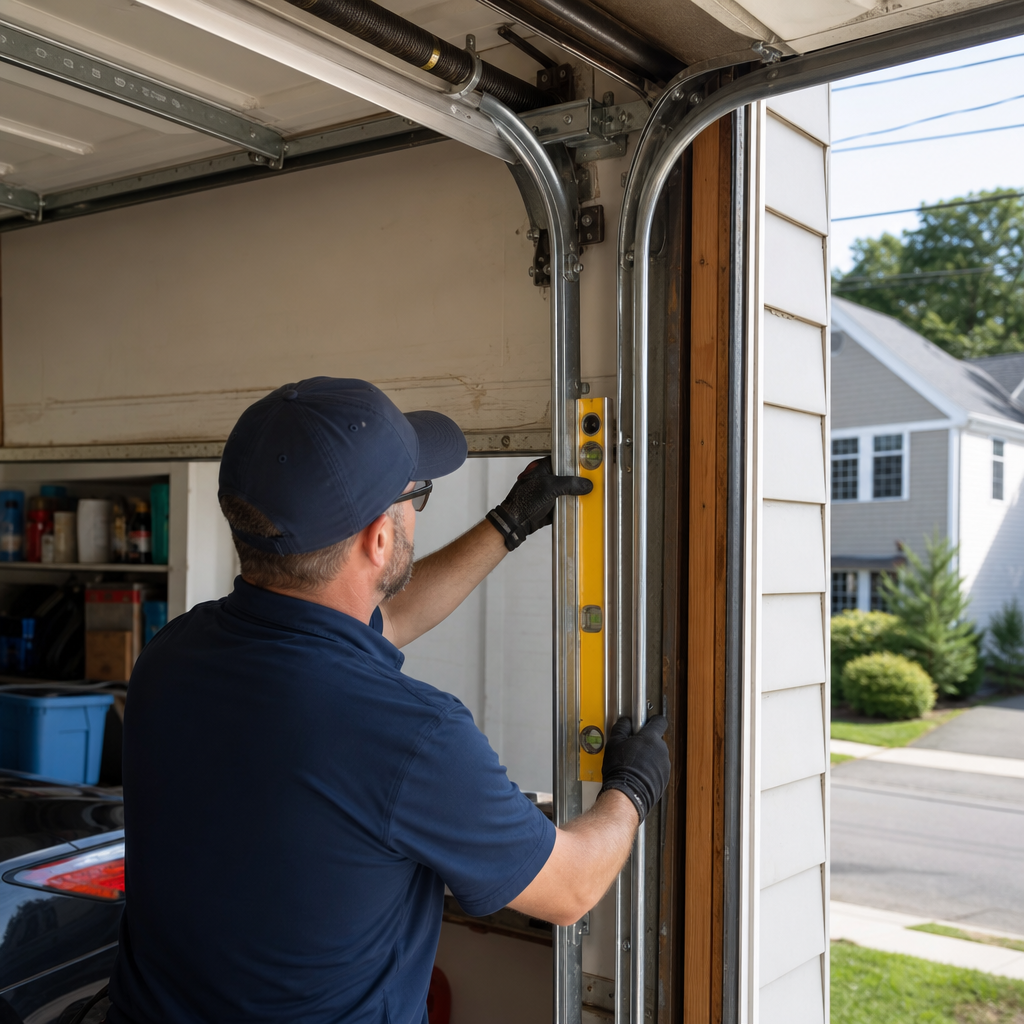
- Track alignment: Use a level on the vertical tracks. They should be plumb within 1/4 inch. Horizontal tracks should slope slightly down toward the back of the garage. Freeze-thaw heaving in older Boston garages — common in Dorchester and Mattapan — frequently knocks tracks out of alignment.
- Spring coil inspection: Look for gaps between coils in the relaxed position (door closed for torsion springs, open for extension springs). A gap means the spring has lost tension and is working harder on each cycle. In our experience, springs that show this in April fail completely by July’s heat — the thermal expansion is the final stress.
- Opener force settings: Test the auto-reverse with a 2×4 laid flat. The door should reverse on contact. If it doesn’t, the force setting may have been adjusted upward to compensate for winter stiffness — a dangerous configuration once the door loosens in warm weather.
We’ve replaced springs in April that the homeowner thought “made it through winter, so they’re fine.” The opposite is true: winter is when damage accumulates visibly. Spring is when you discover it.
Summer Heat and Humidity: The Hidden Stress Season
Boston summers average 70% humidity and increasingly frequent heat waves above 90°F. These conditions affect garage doors in ways that are less dramatic than winter failures but equally consequential for longevity.
Humidity and Wood Doors
Historic districts like Beacon Hill and the South End have significant wood door populations — carriage-house styles, custom panels, older installations. Wood absorbs moisture from humid air, swells across the grain, and can bind in the opening or warp panels.
Check wood doors monthly in July and August for:
- Panel edges rubbing against stiles or rails when opening
- Finish deterioration that allows deeper moisture penetration
- Hardware loosening as wood expands and contracts
A well-maintained wood door in Boston needs refinishing every 2-3 years, more frequently if facing south or west without shade. We’ve seen $8,000 custom Clopay wood doors ruined in four seasons from neglected finish maintenance.
Heat and Spring Tension
Metal springs expand in heat. A torsion spring calibrated correctly in April may be slightly over-tensioned by July, increasing wear on cables, drums, and the opener. The effect is smaller than cold contraction but cumulative — and it combines with the fatigue from winter’s stress.
For doors that see heavy summer use (kids home from school, bikes and beach gear in constant rotation), this is when we see the delayed failures from March’s freeze-thaw damage. The spring that was marginal in April goes over the edge with added thermal expansion and cycle count.
Opener Electronics
Garage temperatures in uninsulated Boston garages can exceed 100°F on July afternoons. Opener motors — particularly older LiftMaster and Craftsman chain-drive units — have thermal cutoffs that shut them down when overheated. If your opener works fine in morning but quits by afternoon, ventilation is the issue, not the motor.
We’ve also seen safety sensor misalignment from humidity-swollen door frames shifting the brackets. The sensors are precise: even 1/4 inch of movement breaks the beam.
The 20-Minute Between-Seasons Check That Prevents 80% of Emergency Calls
This is the procedure we wish every Boston homeowner ran in late October and mid-April. It takes 20 minutes. It requires no tools beyond a flashlight and your eyes. And in our experience servicing Garage Door Repair in Worcester and throughout the region, it catches the developing problems that otherwise become 6 PM emergency calls.
The Checklist
- Visual sweep (5 minutes): With the door closed, inspect the bottom seal for cracks or gaps. Check cables for fraying. Look at springs for coil separation. Note anything that looks different from your memory of last season.
- Manual operation test (5 minutes): Disconnect the opener. Lift the door halfway and release. It should stay in position. Move it through full range — up should be smooth, down should be controlled. Any binding, grinding, or drift indicates a problem.
- Hardware check (5 minutes): With the door closed, wiggle each hinge and roller. Tighten any obviously loose bolts with a socket wrench — but only hardware you can see and reach safely. Do not touch spring hardware or cable attachments.
- Opener safety test (5 minutes): Reconnect the opener. Test auto-reverse with a solid object. Test photo-eye obstruction — wave a broom through the beam while closing. Both should reverse immediately. Listen for straining or unusual noise.
What you find determines your next step. Smooth operation, intact seals, no fraying, and proper safety function? You’re set for the season. Anything else? Address it now, before the season’s stress makes it worse.
For homeowners considering Garage Door Installation in Worcester or Boston, we build this maintenance accessibility into our installation approach — but the check works on any door, any age, any brand.
Common Mistakes to Avoid
- Using the opener to force a stuck door: This strips opener gears and can twist door panels. In Boston’s freeze-thaw conditions, a door stuck in March may free by afternoon — or have a mechanical issue needing professional attention. Forcing it with the motor turns a $150 repair into a $600 replacement.
- Applying standard WD-40 as a lubricant: It’s a solvent, not a lubricant. It displaces water temporarily but leaves metal surfaces dry and attracts abrasive grit. Use silicone spray or lithium grease rated for your temperature range.
- Ignoring the bottom seal until water enters the garage: By then, you’ve also invited road salt that corrodes bottom brackets and track. In coastal Boston neighborhoods, salt air accelerates this damage significantly.
- DIY spring adjustment: Torsion springs store lethal energy. We’ve seen serious injuries from homeowners using incorrect tools or following generic online videos. This is never a DIY task — the risk-reward is indefensible.
- Waiting for total failure: A noisy door, slow operation, or intermittent remote response are early warnings. In our experience, 480 neighbors agree — addressing these early prevents the 5 AM discovery that your car is trapped inside.
- Neglecting opener maintenance: Chain-drive openers need periodic tension adjustment and lubrication. Belt-drive units need belt inspection. We’ve replaced perfectly good Garage Door Opener in Worcester and Boston homes because neglected maintenance killed the unit prematurely.
- Assuming “it worked last winter” means it’s fine: Metal fatigue is cumulative. The spring that survived last January is weaker now. The cable that didn’t fray last year has another year of corrosion. Seasonal checks matter precisely because damage accumulates invisibly.
When to Call a Professional
Some maintenance is homeowner-appropriate. Some crosses into genuine hazard. Call a professional when you encounter:
- Any spring issue — broken, gapped, or noisy coils. Torsion springs are under extreme tension and can cause severe injury or death if mishandled.
- Frayed or damaged cables. These carry full door weight and whip unpredictably if they fail under load.
- Door that won’t stay open manually, indicating spring balance failure.
- Track damage or misalignment beyond minor bolt tightening.
- Opener electrical issues, burning smell, or repeated thermal shutdown.
Larry leads every job at Sequoia Garage Door Repair Massachusetts, and we offer free estimates in Boston — call (833) 754-8144. With 8 years of focused garage door expertise and training across LiftMaster, Chamberlain, Genie, and other major brands, we diagnose quickly and repair correctly the first time. Our 480 verified reviews at 4.8 stars reflect what happens when the owner doing the work is accountable for the result.
Frequently Asked Questions
Professional seasonal tune-ups in the Boston market typically range from $89–$150 for standard residential doors, with premium or wood doors running slightly higher. This usually includes lubrication, hardware tightening, safety testing, and a condition report. At Sequoia Garage Door Repair Massachusetts, we provide free estimates — call (833) 754-8144 for exact pricing on your specific door and brand.
Twice yearly: once in late October before consistent cold, and once in mid-April after the freeze-thaw cycle ends. Use silicone-based spray or lithium grease rated for sub-zero temperatures. Avoid standard WD-40, which is a solvent that leaves metal dry. In coastal neighborhoods like South Boston or East Boston where salt air accelerates corrosion, a light mid-winter touch-up helps.
You can safely free a door frozen to the threshold by disconnecting the opener and applying warm (not boiling) water or low heat from a hair dryer. Never chip ice with metal tools — you’ll damage the seal. Never use the opener to force the door. If the door still doesn’t move smoothly once freed, there’s a mechanical issue requiring professional attention. Forcing it risks stripping opener gears or twisting door panels.
Cold makes metal more brittle, but the primary cause is cumulative fatigue from months of unaddressed wear. A spring that breaks in January was typically weakened by inadequate lubrication, off-balance operation, or heat expansion stress from the previous summer. Boston’s rapid temperature swings — particularly the 40+ degree variations common in March and November — accelerate this fatigue through repeated expansion and contraction.
With proper seasonal maintenance, a quality steel door should last 20–30 years in Boston’s climate. Wood doors require more attention — 15–20 years with faithful refinishing every 2–3 years. Openers average 10–15 years. Without maintenance, we’ve seen doors need major repairs in 7–10 years, particularly in neighborhoods with heavy road salt exposure or coastal air.
Repair is cost-effective when the door structure is sound and the issue is isolated — failed spring, worn opener, damaged panel. Replacement makes sense when multiple systems are failing, the door lacks modern safety features, or repair costs exceed 50% of replacement. In Boston’s historic districts, preserving a well-built older door often makes financial and aesthetic sense. We assess honestly and provide both options — call (833) 754-8144 for a free evaluation.
The Bottom Line
Boston’s four-season climate demands four-season attention. The fall seal and cable inspection determines your winter. The winter lubrication and manual checks prevent spring emergencies. The spring post-freeze inspection catches what March’s variability damaged. The summer humidity and heat monitoring protects wood doors and spring calibration. Miss any link in this chain, and the next season collects the bill — often with interest, in the form of an emergency call when you can least afford the delay. The 20-minute between-seasons check is your best insurance against unexpected failure. And when a problem exceeds your comfort or safety threshold, one call reaches Larry Peterson directly — owner, lead technician, and the person accountable for getting your door back in working order.
Written by Larry Peterson, Owner & Lead Technician at Sequoia Garage Door Repair Massachusetts, serving Boston since 2018.