
Last updated July 10, 2026
Garage Door Repair Maintenance Checklist for Boston Homeowners
Every October, the same preventable repairs stack up in Boston garages: stretched springs that spent all summer ignored, dried-out rollers that seized when the temperature dropped, and bottom seals that were already cracked before the first frost hit. After eight years of opening Boston garage doors that wouldn’t budge on the coldest mornings, Larry Peterson has learned that most failures aren’t mysteries—they’re maintenance tasks that were done at the wrong time, with the wrong product, or not at all. This guide maps your garage door maintenance to Boston’s actual climate calendar, not the generic advice written for temperate zones. You’ll learn which three components fail first after a New England winter, how to spot a spring within 30 days of breaking, and why WD-40 on your rollers is worse than no lubrication at all.
Quick Answer
Boston homeowners should inspect garage door springs, rollers, and weather seals monthly from November through March, lubricate all moving parts with silicone-based spray every October and April, and test door balance and auto-reverse safety features quarterly. The critical difference in Boston’s climate is timing: most components fail not from age alone, but from thermal cycling—expansion in humid summers and contraction in sub-zero winters—that accelerates wear on metal and rubber parts faster than in milder regions.
Table of Contents
- Why Boston’s Climate Demands a Different Maintenance Calendar
- Monthly Winter Inspection: The Three Components That Fail First
- Spring and Summer Maintenance Tasks
- How to Lubricate Correctly (And Why WD-40 Destroys Rollers)
- Visual Signs Your Spring Is Within 30 Days of Failure
- DIY-Safe Tasks vs. What Requires a Trained Technician
- Common Mistakes to Avoid
- When to Call a Professional
- Frequently Asked Questions
Why Boston’s Climate Demands a Different Maintenance Calendar
Generic garage door checklists split the year into “spring” and “fall” maintenance. That works in Charlotte or San Diego. In Boston, your garage door endures temperature swings of 80 degrees or more within a single season, salt-laden air from coastal storms, and freeze-thaw cycles that turn small cracks into component failures.
Here’s what actually happens to garage doors in Boston neighborhoods from Back Bay to Roslindale:
- October temperature drops cause metal springs to contract rapidly; coils that were marginal in September often snap in the first cold snap of November
- January dry air pulls moisture from nylon rollers and rubber seals, making them brittle just when they’re compressed against frozen thresholds
- March freeze-thaw cycles create standing water that corrodes bottom brackets and rusts steel cables at their anchor points
- July humidity swells wooden door panels on older homes in Jamaica Plain and Dorchester, throwing off track alignment
The maintenance calendar below is built around these realities. Larry Peterson developed this sequence after tracking which calls came in when, and what the failed component had in common. In our experience at Sequoia Garage Door Repair Massachusetts home, roughly 60% of emergency winter calls in Boston trace back to maintenance that should have happened in October.
Monthly Winter Inspection: The Three Components That Fail First
After every Boston winter, three components dominate our repair log: torsion springs, nylon rollers, and bottom weather seals. Here’s how to inspect each in under ten minutes, once a month from November through March.
1. Torsion Springs (Visual Inspection Only—Do Not Touch)
Stand inside your garage with the door closed. Look at the coil springs mounted horizontally above the door opening. You’re checking for:
- Coil gaps that are uneven—a healthy spring has consistent spacing between coils; gaps that are wider on one side indicate metal fatigue
- Rust streaks or orange dust on the spring body or the tube it’s mounted on—this is active corrosion weakening the steel
- A stretched or elongated appearance—the spring should look tightly wound, not like it’s struggling to hold its shape
Safety note: Torsion springs store massive mechanical energy. A standard residential spring holds enough force to cause serious injury or death if it releases unexpectedly. Never attempt to adjust, unwind, or replace a torsion spring yourself. This inspection is visual only.
2. Nylon Rollers (Listen and Look)
With the door closed, run it through one complete open-close cycle. Listen for grinding, squealing, or a rhythmic “thunk” as each roller passes through the curved section of track. Then, with the door open, examine two rollers on each side:
- Spin each roller by hand—it should turn freely with light resistance
- Check for cracks in the nylon wheel, especially at the hub where it meets the steel shaft
- Look for flat spots or deformation where the roller contacts the track
Cold-nylon rollers in Boston’s January garages often crack without warning. A failed roller can derail the door from its track, causing costly panel damage or personal injury.
3. Bottom Weather Seal (Feel and Inspect)
Close the door and crouch at the threshold. Run your hand along where the rubber seal meets the concrete. You’re feeling for:
- Hard spots or sections that don’t compress—the seal should be pliable even in cold weather
- Cracks that open when you flex the rubber—these let in meltwater that refreezes and glues your door shut
- Gaps where light shows through—even pencil-width gaps admit enough air to freeze pipes in attached garages
In South Boston and waterfront neighborhoods, salt spray accelerates rubber degradation. Homeowners there often need seal replacement every 2-3 years versus 4-5 years inland.
Spring and Summer Maintenance Tasks
Once Boston’s freeze risk passes, shift from inspection to active maintenance. April and May are your window to address what winter stressed and prepare for summer humidity.
Door Balance Test (Quarterly, Year-Round)
A properly balanced door puts minimal strain on your opener. Here’s the test:
- Disconnect the opener by pulling the red emergency release cord
- Manually lift the door to waist height and release it
- A balanced door stays in place or drifts slowly; an unbalanced door slams down or rockets upward
Imbalance usually means spring tension is off. In Boston, we see balance shift noticeably after harsh winters as springs fatigue unevenly. If your door fails this test, the spring needs professional adjustment—this is not a DIY task.
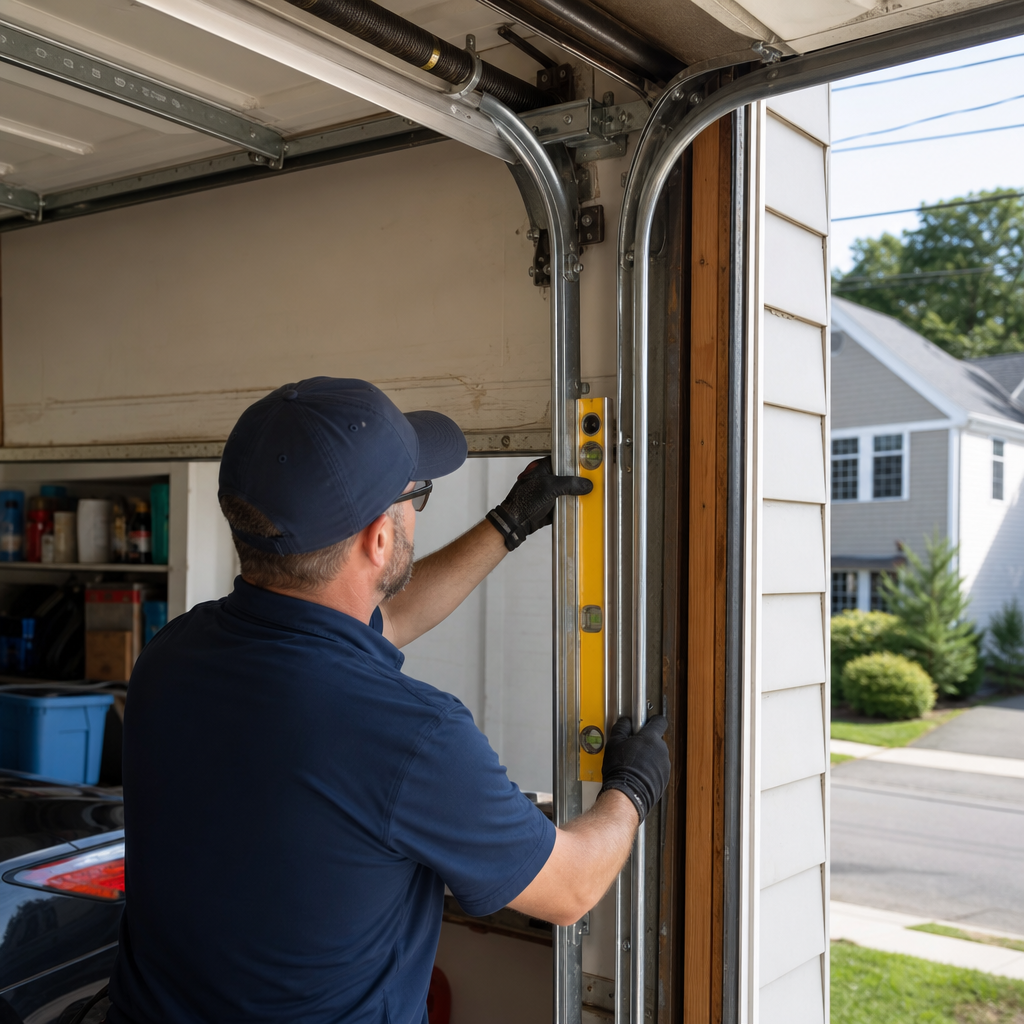
Track Alignment and Hardware Tightening (April and October)
With the door closed, examine the vertical tracks on each side:
- The gap between track and door edge should be consistent top to bottom—typically 1/2 to 3/4 inch
- Track mounting brackets should be firmly bolted to the wall framing; loose brackets let tracks flex and wear rollers unevenly
- Look for metal shavings or black nylon dust at the base of the track—this is wear debris indicating failing rollers
Tighten any loose bolts with a socket wrench, but never loosen track mounting bolts unless you know how to realign properly. Misaligned tracks are a leading cause of door derailment.
Auto-Reverse Safety Test (Monthly)
Federal law requires all automatic openers manufactured after 1993 to have auto-reverse. Test both triggers:
- Mechanical test: Place a 2×4 board flat on the floor where the door closes. The door must reverse within 2 seconds of contact.
- Photoelectric test: Wave a broom handle through the beam while the door is closing. It must reverse immediately.
If either test fails, the opener needs service. In Boston’s older housing stock—think triple-deckers in Somerville and Cambridge—opener photoelectric sensors often get knocked out of alignment by storage items or kids’ bikes.
How to Lubricate Correctly (And Why WD-40 Destroys Rollers)
This is the most common maintenance error Larry Peterson encounters in Boston homes, and it’s not close. WD-40 is not a lubricant for garage door components. It’s a water displacer and light solvent. Here’s what happens when you use it:
- It strips away existing grease from steel gears and chain drives
- It attracts dust and grit that forms an abrasive paste on rollers and hinges
- It evaporates within days, leaving metal-on-metal contact that accelerates wear
We’ve replaced rollers on 4-year-old doors that should have lasted 15 years because the homeowner “maintained” them with WD-40 twice yearly. In Garage Door Repair in Worcester and throughout our Boston service area, this is a $200-$400 mistake that costs about $8 to prevent.
The Correct Products and Application
For Boston’s temperature extremes, use these:
| Component | Product Type | Application Notes |
|---|---|---|
| Hinges, rollers (metal), bearings | Silicone-based spray lubricant | Light coat; wipe excess to prevent dust adhesion |
| Torsion spring | Silicone spray or lithium grease | Coat entire spring surface to prevent corrosion |
| Chain or screw drive opener | Manufacturer-specified grease | LiftMaster/Chamberlain/Genie each specify different products |
| Weather seal | Silicone spray (light) | Prevents drying and cracking; apply when seal is clean and dry |
When to lubricate in Boston: Mid-October, before the first sustained cold, and mid-April, after the final freeze risk. Never lubricate when temperatures are below 40°F—the carrier solvents won’t evaporate properly and the lubricant stays gummy.
Application technique matters: spray, wait 30 seconds, then operate the door through two cycles to distribute. Wipe any drips. A properly lubricated door runs quieter and puts less load on the opener motor, extending its life significantly.
Visual Signs Your Spring Is Within 30 Days of Failure
Spring failure is the most disruptive garage door problem because it usually traps your car inside or outside, often at the worst possible moment. After eight years and hundreds of spring replacements across Boston, Larry Peterson can spot the warning signs that homeowners miss.
Here’s what to look for during your monthly winter inspection:
- The “two-inch gap” rule: When the door is closed, measure the gap between coils at the tightest point. If any gap exceeds two inches on a standard 7-foot door spring, the spring has stretched beyond its design limit. We’ve seen this in Charlestown rowhouses where heavy wooden doors stress springs continuously.
- Coil deformation: A healthy spring is a perfect cylinder. If you see any section that bulges outward, narrows, or has a “kinked” appearance, the internal structure is failing. This is especially common after Boston’s temperature swings cause uneven expansion and contraction.
- Symmetrical wear pattern: On dual-spring systems (most doors over 16 feet wide), compare left and right springs. If one looks noticeably more stretched or corroded than the other, it’s carrying excess load and will fail first—often within days of the visible asymmetry appearing.
- Operational changes: The door feels heavier to lift manually, the opener strains or stalls at the same point in the cycle, or the door closes faster than it used to. These all indicate declining spring assistance.
The critical insight: springs almost never fail without warning. They signal for weeks. The homeowners who call us for scheduled replacement pay $180-$340 and pick their timing. Those who wait for the snap pay the same, plus emergency fees, plus the inconvenience of a trapped vehicle on a workday morning.
In Boston’s Back Bay and Beacon Hill, where many homeowners park in alley-access garages, a failed spring can mean missing a flight or an important meeting. The 10-minute monthly inspection is cheap insurance.
DIY-Safe Tasks vs. What Requires a Trained Technician
Honest assessment matters for safety and your wallet. Here’s the dividing line based on actual risk, not liability-lawyer caution.
Genuinely DIY-Safe
- Visual inspections of springs, cables, rollers, and hardware—no tools required, no contact with tensioned components
- Lubrication of hinges, rollers, and weather seals with proper products
- Balance test using the emergency release and manual lift
- Auto-reverse testing with a 2×4 and photoelectric beam interruption
- Cleaning tracks with a dry cloth to remove debris and old lubricant buildup—never use water, which promotes rust
- Tightening loose bolts on hinges, handles, and track brackets with a socket wrench
Requires Professional Training and Tools
- Torsion spring adjustment or replacement: Winding bars must be inserted into a tensioned spring to add or release torque. The energy release if a bar slips can cause head trauma, hand amputation, or death. Larry Peterson uses specialized winding bars and follows a specific safety protocol developed through formal training and hundreds of repetitions.
- Cable drum or cable replacement: These work with the spring system and are under similar tension. A frayed cable can snap unpredictably during service.
- Track realignment: Requires precise measurement and leveling; improper alignment causes binding, roller failure, and potential door drop.
- Opener installation or major repair: Electrical work, force limit calibration, and safety system integration need brand-specific knowledge. Sequoia Garage Door Repair Massachusetts works fluently across LiftMaster, Chamberlain, Genie, Craftsman, and Raynor systems—each has distinct programming procedures.
The honest reason to hire a pro for tensioned components: the tools cost more than the service call, the training takes years to internalize, and the injury risk is permanent. We’ve responded to homeowner attempts that ended with the door off its tracks, damaged panels, or worse. For Garage Door Installation in Worcester or anywhere in our Boston service area, Larry leads every job personally—one call, one expert, no subcontractor roulette.
Common Mistakes to Avoid
- Using WD-40 as lubricant: As detailed above, this solvent strips protective grease and attracts abrasive grit. In Boston’s sandy coastal environment, WD-40ed rollers grind themselves to failure in 18 months.
- Ignoring the door after a power outage: Many Boston homeowners discover their door is unbalanced only when they first use the emergency release during a winter storm outage. Test balance quarterly, not during emergencies.
- Applying lubricant to the track itself: The track is not a friction surface—rollers roll, they slide. Lubricated tracks collect dust that gunks up roller bearings. Clean tracks dry; lubricate rollers, hinges, and springs only.
- Delaying seal replacement until water enters: A cracked bottom seal in October becomes an ice-locked door in January. In flood-prone Boston neighborhoods like East Boston and along the Charles, water intrusion also damages stored items and can wick into wall framing.
- Assuming all springs are the same: Door weight, height, and track configuration determine spring specification. A “similar” spring from a hardware store can overstress your opener or fail prematurely. Larry specifies springs by door weight and cycle rating—typically 10,000 cycles for residential use in Boston.
- Neglecting the exterior finish on wooden doors: In humid Boston summers, unsealed wood absorbs moisture and swells, throwing off track alignment. Inspect and reseal wooden doors annually, especially on south-facing exposures.
- Testing auto-reverse with a person: Never. Use a 2×4 or solid object. The safety system exists because garage doors have killed children and pets; verify it properly.
When to Call a Professional
Call for service when you identify any of the spring warning signs above, when the door fails the balance test, when auto-reverse malfunctions, or when you hear new grinding or banging sounds. Also call if the door has been hit by a vehicle, even slightly—impact damage to tracks or panels often isn’t visible but causes progressive misalignment.
Emergency situations include: a broken spring with the door open (it can crash closed), a door off its tracks, or any situation where the door is stuck open and compromises home security. Sequoia Garage Door Repair Massachusetts offers emergency garage door service for these urgent repair situations—when a broken door isn’t just an inconvenience, it’s a security risk.
For non-urgent concerns, Garage Door Opener in Worcester and throughout our Boston coverage area, Sequoia Garage Door Repair Massachusetts provides free estimates. Call (833) 754-8144 to schedule with Larry Peterson directly. Larry leads every job, and 480 neighbors agree—the 4.8-star average reflects consistent, accountable service.
Frequently Asked Questions
Professional annual maintenance in the Boston market typically runs $120-$180 for a standard residential door, which includes full inspection, lubrication with proper products, balance test, safety system verification, and minor hardware tightening. Spring replacement when scheduled (not emergency) ranges $180-$340 depending on spring type and door size. Call (833) 754-8144 for an exact quote—estimates are free.
Yes, for visual inspections, lubrication, balance testing, and auto-reverse verification—roughly 60% of annual maintenance value. No, for any work involving torsion springs, cable drums, or track realignment. The dividing line is tension: if a component stores mechanical energy that could release unexpectedly, it requires specialized training and tools. We’ve seen well-intentioned DIY spring attempts end with emergency room visits.
Inspect monthly November through March, lubricate in mid-October and mid-April, and test balance and auto-reverse quarterly year-round. Boston’s freeze-thaw cycles and coastal humidity demand more frequent attention than the generic “twice yearly” advice you’ll find on non-local sites. Homes within a mile of the harbor or Charles River should inspect seals monthly year-round due to salt exposure.
Dried, cracked bottom seals that were ignored in October, then froze to the threshold in January. The homeowner forces the opener, stripping gears or burning out the motor. A $25 seal becomes a $400 opener replacement. Second most common: WD-40ed rollers that failed prematurely. Both are October maintenance items.
For doors under 15 years with isolated component failures, repair is almost always more economical—spring replacement at $180-$340 versus $1,200-$2,800 for new door and installation. Consider replacement when: the door has significant panel damage, the opener is obsolete and parts are unavailable, or repair costs exceed 50% of replacement within a 5-year window. Larry provides honest assessment on repair-versus-replace questions during free estimates.
Sequoia Garage Door Repair Massachusetts maintains emergency garage door service availability for situations where a broken door creates security exposure or traps a vehicle. Response time varies by current job load and your location within Boston, but we prioritize true emergencies. For fastest service, call (833) 754-8144 and describe your situation—Larry will give you a realistic timeframe and immediate guidance on securing your garage if needed.
The Bottom Line
Boston’s garage doors fail predictably because the climate is predictable. The homeowners who avoid emergency repairs are those who time their maintenance to the actual weather calendar: October lubrication before cold, monthly winter inspections for the big three (springs, rollers, seals), spring hardware checks after thaw, and quarterly balance and safety tests year-round. Use silicone spray, never WD-40. Inspect visually, but never touch tensioned springs. Know the 30-day spring warning signs so you choose your repair timing. And when professional service is needed, choose accountability over anonymity—one expert who answers for the work, not a dispatched stranger.
Written by Larry Peterson, Owner & Lead Technician at Sequoia Garage Door Repair Massachusetts, serving Boston since 2018.