
Last updated July 10, 2026
Garage Door Permits, Codes & Inspections in MA: What You Need to Know
A Worcester homeowner nearly lost their sale at closing when the buyer’s inspector flagged an unpermitted garage door opener installation done by a previous owner. Three weeks of back-and-forth with the city, a retroactive electrical inspection, and a frayed relationship later, the deal closed — barely. Here’s the counterintuitive truth: most garage door work in Massachusetts doesn’t need a permit, but the exceptions are specific, consequential, and routinely misunderstood by both homeowners and some contractors. In this guide, we’ll walk you through exactly when Boston-area building departments want paperwork, when they don’t, and how to protect yourself from the surprises that show up at resale.
Quick Answer
Most garage door repairs and direct replacements in Massachusetts do not require a permit under the MA State Building Code. However, you’ll need one for structural changes to the opening, fire-rated door installations between an attached garage and living space, and new electrical circuits for openers in many municipalities including Boston and Worcester. Always verify with your local building department before work begins — permit gaps become the seller’s problem at closing.
Table of Contents
- When Is a Garage Door Permit Required in Massachusetts?
- Fire-Rated Doors: The Code Point Most Boston Homes Miss
- Garage Door Opener Electrical Work and Permits
- How Boston, Worcester, and Surrounding Towns Interpret the Code Differently
- Why Some Contractors Skip the Permit Conversation
- How to Check Your Property’s Permit History Before Hiring Anyone
- Common Mistakes to Avoid
- When to Call a Professional
- Frequently Asked Questions
- The Bottom Line
When Is a Garage Door Permit Required in Massachusetts?
The Massachusetts State Building Code, 9th Edition, bases permit requirements on the scope of work rather than the component itself. This distinction trips up a lot of homeowners. Here’s how it breaks down in practice across the Boston metro area.
No Permit Required (Direct Replacement)
You generally do not need a permit when you’re doing a like-for-like swap: same size opening, same type of door, no structural modifications. This covers the majority of garage door replacements we handle in Boston neighborhoods from Roslindale to West Roxbury. The door goes into the existing frame, the tracks mount to the existing jambs, and nothing about the building envelope changes.
Specific examples that don’t require permits:
- Replacing a damaged steel panel door with a new steel panel door of identical dimensions
- Upgrading from an uninsulated door to an insulated model (same size, same mounting)
- Swapping out a broken torsion spring or worn cables
- Replacing a malfunctioning opener with a new unit on the existing electrical supply
- Installing new weatherstripping, rollers, or hardware
Permit Required (Structural or Safety-Critical Changes)
The line crosses when you alter the structure, the fire separation, or add new electrical. These situations trigger Chapter 1 of the MA State Building Code and local amendments:
- Changing the rough opening size — widening a single door to a double, raising the header height, or converting a window to a door opening. This affects load-bearing calculations and requires structural review.
- Installing a fire-rated door between garage and living space — required by code for attached garages, and the installation itself needs inspection verification. More on this in the next section.
- Adding a new electrical circuit for an opener — many Boston-area towns require an electrical permit and inspection for any new dedicated circuit, even if the work seems minor.
- Converting a garage to conditioned living space — triggers full building, electrical, and energy code compliance.
- Installing a new door in a previously door-less opening — such as a carport enclosure or new construction garage.
We’ve seen homeowners in Dorchester and Mattapan assume that “it’s just a door” and skip the permit step on opening modifications. The headache arrives years later when a refinance or sale triggers a records search. Boston’s Inspectional Services Department maintains permit records back decades, and gaps are easy to spot.
Fire-Rated Doors: The Code Point Most Boston Homes Miss
If your home has an attached garage — and most suburban Greater Boston homes built after 1978 do — the door connecting that garage to your living space is almost certainly required to be fire-rated. This isn’t your garage’s overhead door; it’s the pedestrian door you walk through to get inside.
What the Code Actually Says
Massachusetts follows the International Residential Code with state amendments. Section R302.5.1 requires a 20-minute fire-rated door, or equivalent construction, between an attached garage and the dwelling unit. The door must be self-closing or equipped with a closer. The intent is to slow fire spread from a garage — where gasoline, solvents, and vehicle fuel create elevated risk — into sleeping areas.
Here’s where Boston-area homeowners get caught:
- Replacing an original fire-rated door with a standard hollow-core interior door — common after water damage or aesthetic renovations
- Removing the self-closing mechanism because “the spring was annoying”
- Installing a pet door or mail slot that compromises the fire rating
- Converting the garage to a workshop or gym without verifying the separation assembly
What “Fire-Rated” Means in Practice
A 20-minute fire-rated door has been tested to withstand fire exposure for that duration. It’s not about the door being fireproof; it’s about buying time for escape and limiting smoke migration. Brands like Clopay and Wayne Dalton manufacture garage-side entry doors that meet this rating, though many homeowners don’t realize their existing door may already comply if it’s a solid-core or labeled model from the original construction.
In our 8 years working across Boston, we’ve encountered this issue most often in homes from the 1980s and 1990s in neighborhoods like Hyde Park and Readville, where original doors have been swapped out during basement finishing projects. The homeowner never knew the replacement needed to maintain the fire rating. At resale, the home inspector catches it, and suddenly there’s a pre-closing repair with permit implications.
Inspection and Documentation
If you’re replacing a garage-to-house door, check for a fire-rating label on the edge or top of the existing door. If it’s present, photograph it before removal. If you’re installing new, the door should carry a UL or Warnock Hersey label indicating the 20-minute rating. Some Boston-area inspectors will want to verify the installation; others treat it as a replacement-with-like. Call your local building department before ordering.
Garage Door Opener Electrical Work and Permits
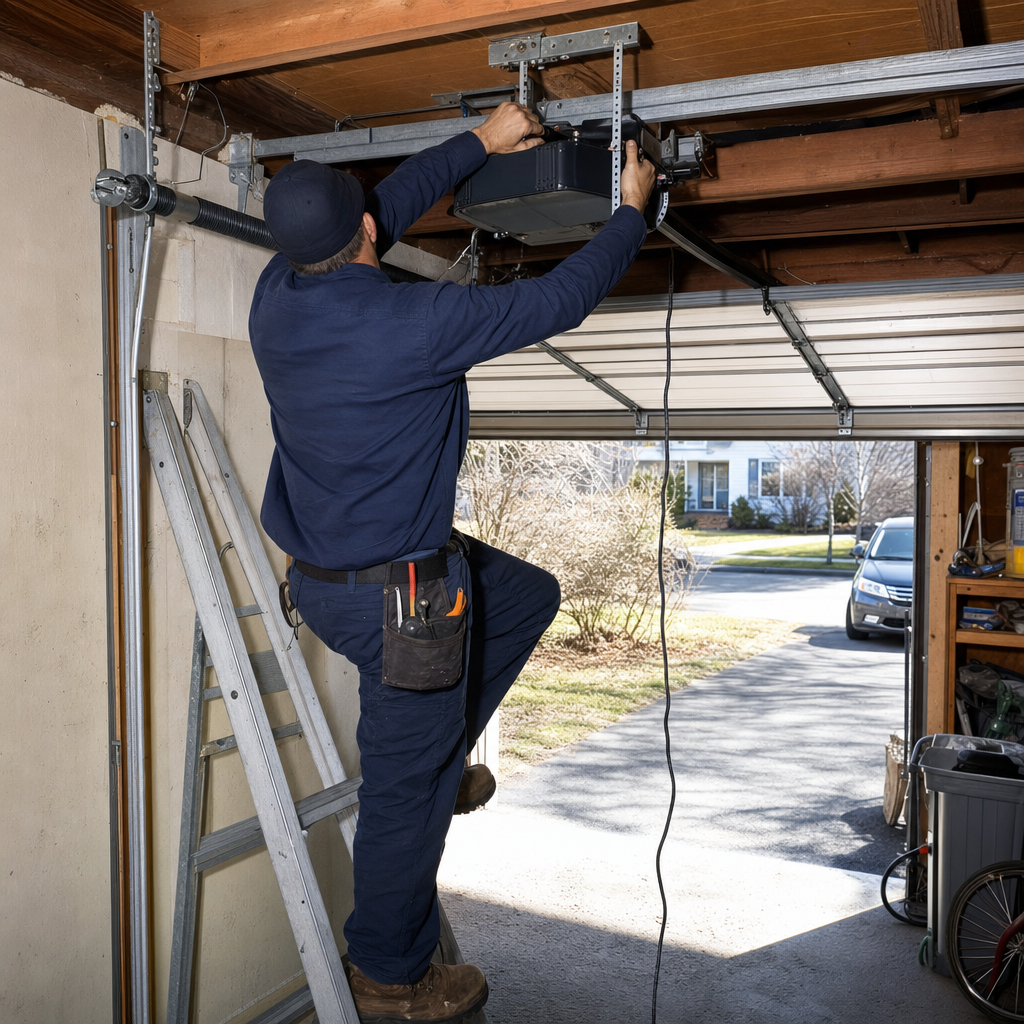
This is the category that generates the most confusion — and the most resale surprises. The opener itself doesn’t need a permit. The electrical work feeding it very well might.
The Critical Distinction
Under Massachusetts electrical code (527 CMR 12.00), a replacement opener connected to an existing outlet or junction box typically doesn’t trigger permitting. The circuit already exists; you’re just changing the load. But scenarios that often do require an electrical permit include:
- Adding a new dedicated circuit from the panel to support a heavier opener (common with jackshaft or high-lift installations)
- Installing an opener where none existed before — older Boston garages, particularly in triple-deckers and pre-war homes, sometimes lack overhead electrical
- Upgrading from 120V to 240V for a commercial-grade or high-cycle opener
- Adding receptacles, lighting, or smart-home wiring as part of the opener installation
Municipal Variation Matters
Boston’s Inspectional Services Department generally requires electrical permits for new circuits, enforced through licensed electrician filing. Worcester takes a similar position. But we’ve seen variation in surrounding towns — some accept homeowner electrical permits for their own residences, others don’t. Some require inspection of the panel capacity, others only the new work.
The practical risk: an unpermitted electrical addition for an opener won’t show up in routine use. It only surfaces when someone checks. In Boston’s tight housing market, buyers and their inspectors are increasingly thorough. A quick search of Boston’s online permit portal (more on that below) reveals gaps instantly.
Safety Note on Electrical Work
Garage door openers involve line-voltage electrical connections and, in older Boston homes, potentially outdated wiring. If your panel has fuses rather than breakers, or if you’re unsure about grounding, this isn’t a homeowner project. Faulty opener electrical work can create fire hazards or electrocution risk, particularly in damp garage environments common in Boston’s coastal climate. We recommend a licensed electrician for any new circuit work, with permit filing as standard practice.
How Boston, Worcester, and Surrounding Towns Interpret the Code Differently
Massachusetts has a state building code, but local amendments and enforcement culture create real differences across the metro area. Understanding your municipality’s posture saves time and prevents assumptions.
Boston: Structured but Searchable
Boston’s Inspectional Services Department (ISD) maintains robust online records back to the mid-1990s for most properties. Permitting is structured around the state’s base code with Boston-specific amendments. For garage door work, Boston ISD generally follows the direct-replacement exemption but requires permits for structural opening changes and new electrical. The city also enforces energy code compliance for new installations, which can affect door U-factor requirements in conditioned or heated garages.
One Boston-specific factor: the city’s older housing stock. In neighborhoods like Jamaica Plain, South Boston, and East Boston, garages are often converted carriage houses, basement-level parking bays, or post-war additions with non-standard construction. What looks like a simple replacement may trigger historical review or zoning verification if the structure predates modern code adoption.
Worcester: Practical Enforcement with Local Nuance
Worcester’s Building Department tends toward practical enforcement — they’ll tell you directly whether your project needs a permit. The city has seen significant garage conversion activity in recent years, particularly in triple-decker renovations, and inspectors are attuned to fire-separation issues. Worcester also requires permits for any work that changes the exterior appearance in designated historic districts, which can include garage door style or color changes in certain neighborhoods.
For homeowners in Worcester, garage door repair in Worcester and garage door installation in Worcester through Sequoia includes upfront discussion of permit requirements specific to your project and property records.
Surrounding Suburbs: The Wildcard
Brookline, Cambridge, Somerville, Newton, and Quincy each have their own building departments with varying online presence and response speed. Some key patterns we’ve observed:
- Cambridge and Somerville: Strong enforcement of energy code; new garage doors in heated garages may need to meet specific U-factor and air leakage standards
- Brookline and Newton: Historic district overlays can trigger design review even for “invisible” garage door replacements if street-facing
- Quincy and South Shore towns: Coastal flood zone considerations can affect garage door requirements in FEMA-designated areas, particularly for living-space conversions
- Smaller towns: May rely on state inspectors or contracted services; permit turnaround varies from same-day to several weeks
The consistent advice: never assume. A two-minute phone call to your local building department clarifies requirements and protects your resale position.
Why Some Contractors Skip the Permit Conversation
This section addresses a reality that homeowners rarely hear about directly. Permit avoidance happens, and understanding why helps you evaluate contractor proposals.
The Incentives to Avoid Permits
For some contractors, skipping permits offers clear short-term advantages:
- Faster job completion — no waiting for inspection scheduling, no return visits for inspector sign-off
- Lower apparent cost — permit fees ($50–$200+ depending on municipality and scope) aren’t quoted, making the bid seem competitive
- No inspector scrutiny — particularly relevant for contractors whose work wouldn’t pass, or who lack proper licensing
- Avoiding liability insurance notification — some policies require permit compliance for claims coverage
What Shifts to the Homeowner
When a contractor does unpermitted work that should have been permitted, the liability doesn’t stay with them. It transfers to you as the property owner. Specific risks include:
- Resale complications — unpermitted work must be disclosed in Massachusetts; buyers can negotiate price reductions or walk away
- Insurance denial — if fire or structural damage traces to unpermitted work, your carrier may deny coverage
- Forced remediation — some municipalities can require removal or reconstruction of unpermitted work at owner expense
- No contractor accountability — unpermitted work often means no inspection record, making warranty claims harder to enforce
We’ve been called to fix opener installations in Boston where the original contractor disappeared and the homeowner discovered — too late — that the electrical was unpermitted and improperly grounded. The “savings” on the original job evaporated into emergency electrical repair and permit retroactivity.
At Sequoia Garage Door Repair Massachusetts home, we discuss permit requirements as part of every proposal. If your project needs a permit, we’ll tell you. If it doesn’t, we’ll document why. Larry leads every job, and that accountability includes being transparent about regulatory requirements — not hoping the homeowner doesn’t ask.
How to Check Your Property’s Permit History Before Hiring Anyone
Due diligence on your own property takes ten minutes and can reveal surprises that shape your project scope.
Step-by-Step: Boston and Surrounding Municipalities
- Locate your property’s Parcel ID or address — you’ll need the exact street address, sometimes the owner’s name as of record
- Search Boston’s online portal at boston.gov/departments/inspectional-services (for Boston properties) or your municipality’s equivalent
- Review the permit history — look for building permits, electrical permits, and certificates of inspection related to garage or structural work
- Note gaps or anomalies — a garage addition with no building permit, an opener installation with no electrical permit, or permits closed without final inspection
- Request a physical file review if needed — older records may not be digitized; Boston ISD allows in-person review at 1010 Massachusetts Avenue
- Ask your contractor to verify — a professional should confirm permit status before work begins, not after
What to Look For
Specific red flags in permit history:
- Garage structure with no original building permit — common in older additions or DIY projects from prior owners
- Electrical work with no corresponding permit — particularly for subpanel installations or heavy-upgrades
- Open permits never closed with final inspection — these create title issues and may need resolution before sale
- Permits in someone else’s name without proper contractor licensing — Massachusetts requires home improvement contractor registration for jobs over $1,000
In Worcester, the City’s online permitting system covers records from roughly 2000 forward, with older files available through City Hall. For garage door opener in Worcester installations, verifying prior electrical permits is particularly important given the city’s enforcement posture on new circuits.
When to Pull Your Own Permit
Massachusetts allows homeowners to pull their own permits for work on their primary residence, though electrical and plumbing often require licensed trade filing. For garage door work, if you’re managing the project yourself, you can file the building permit directly. If you’re hiring Sequoia Garage Door Repair Massachusetts, we coordinate permit requirements as part of project planning — not as an afterthought.
Common Mistakes to Avoid
- Assuming replacement equals exemption without verifying — a “replacement” that widens the opening or changes the header is structural work requiring a permit, even if the door itself looks similar.
- Ignoring the fire-rated door requirement in attached garages — that solid-core door to your kitchen may not meet the 20-minute rating; check for a label before replacing with a standard interior door.
- Letting electrical work slide — new opener circuits in Boston and Worcester almost always need electrical permits; the homeowner bears the resale risk, not the electrician who “does it on the side.”
- Trusting verbal assurances over written documentation — if a contractor says “permits aren’t needed,” get it in writing with reference to the specific code section; legitimate professionals document their rationale.
- Neglecting to check permit history before closing on a home purchase — Boston’s competitive market pushes fast closings, but unpermitted garage work is a negotiable defect that home inspectors increasingly flag.
- Confusing brand warranty with code compliance — a Craftsman or Amarr door may carry a 20-year warranty and still be installed in violation of local code; the warranty doesn’t protect against permit gaps.
- Waiting until resale to discover the problem — permit verification costs nothing upfront and can save thousands in pre-closing rush repairs.
When to Call a Professional
Permit questions intersect with technical decisions. Call for professional guidance when your project involves structural changes, fire-rated door verification, new electrical circuits, or any work in Boston’s historic districts. Sequoia Garage Door Repair Massachusetts offers free estimates in Boston — call (833) 754-8144. With 8 years specializing exclusively in garage doors and 480 verified reviews averaging 4.8 stars, Larry Peterson personally evaluates each project for permit requirements before work begins. One call, one expert: you’ll speak with the person who’ll be on your job, not a dispatcher reading from a script.
Frequently Asked Questions
No — a direct replacement of the same size door in the same opening generally does not require a permit under the MA State Building Code. However, if you’re changing the opening size, installing a fire-rated door between garage and living space, or adding new electrical for an opener, permit requirements apply. Call your local building department to confirm, or call us at (833) 754-8144 for a free estimate with permit guidance included.
Building permit fees in Boston typically run $50–$150 for garage door structural work, with electrical permits adding $50–$100 depending on circuit scope. Worcester and surrounding towns vary; some charge flat rates, others base fees on project valuation. The cost is minor compared to the resale complications of unpermitted work. We factor permit requirements into every Sequoia proposal so you’re not surprised.
You’ll need to disclose unpermitted work when selling in Massachusetts, and buyers may demand remediation, price reductions, or walk away entirely. Some municipalities allow retroactive permitting with inspection, though this can require exposing finished work. Insurance claims related to unpermitted work may be denied. The sooner you address gaps, the less costly the resolution.
Replacement openers on existing circuits generally don’t, but new dedicated circuits typically do. Worcester’s Building Department enforces electrical permitting for new circuits, and inspection verifies proper grounding and panel capacity. For garage door opener in Worcester projects, we verify your existing electrical and permit needs before installation day.
Check for a label on the door edge or top indicating a 20-minute fire rating from UL or Warnock Hersey. Solid-core doors may meet the requirement without a visible label if original to construction. If you’re replacing the door, match or exceed the existing rating — standard hollow-core interior doors do not comply. When in doubt, photograph the existing door before removal and consult your building inspector.
Homeowners in Massachusetts can pull permits for work on their primary residence, though electrical and plumbing permits often require licensed trade filing. Many homeowners prefer their contractor to handle permitting as part of project management. At Sequoia, Larry coordinates permit requirements directly when they apply — it’s part of the accountability that comes with owner-led service.
The Bottom Line
Massachusetts garage door permitting isn’t complicated, but it’s precise. Most replacements need no paperwork; structural, fire-rated, and electrical work does. The costly errors aren’t technical — they’re assumptions: assuming replacement means exemption, assuming the contractor handled it, assuming the next buyer won’t check. In Boston’s transparent market, they will. Verify your property’s permit history, confirm requirements with your local building department, and work with professionals who document their compliance. The ten minutes of prevention saves weeks of closing-table panic.
Written by Larry Peterson, Owner & Lead Technician at Sequoia Garage Door Repair Massachusetts, serving Boston since 2018.