
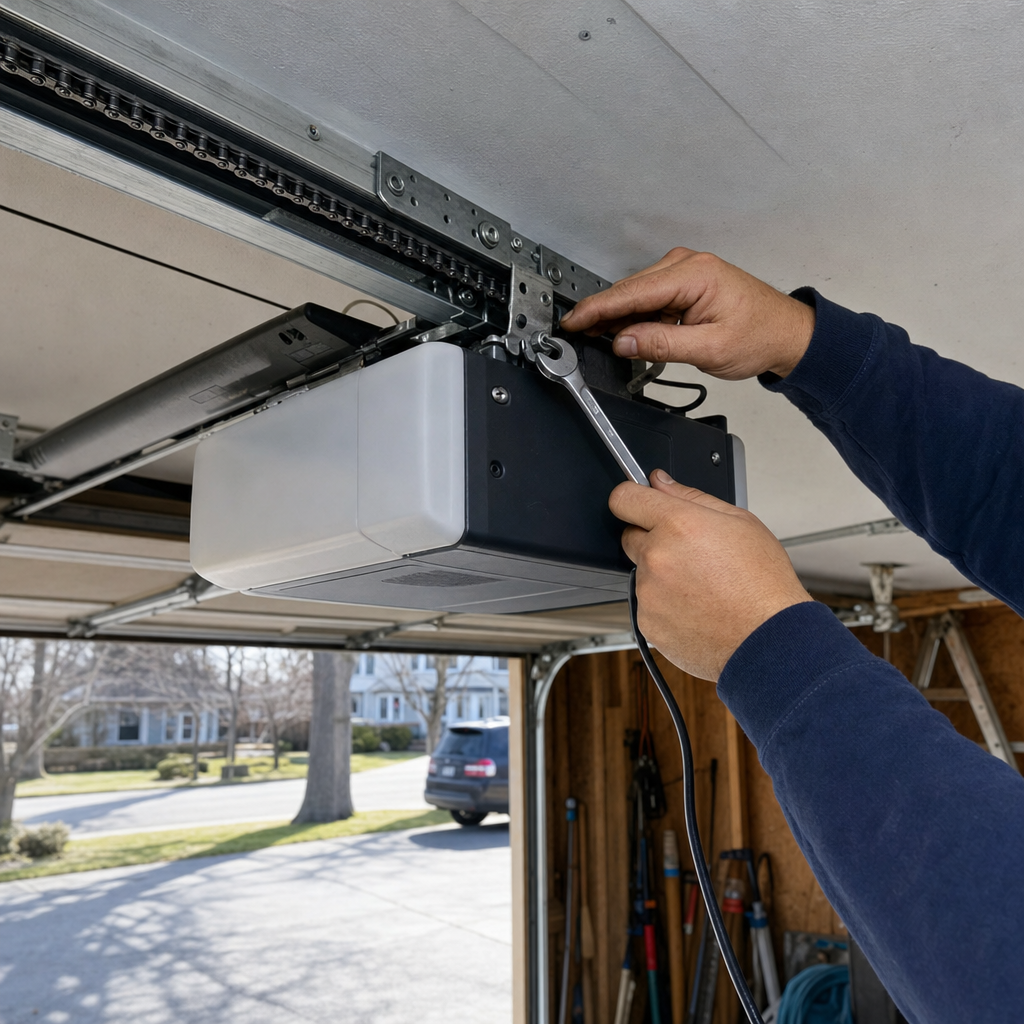
Garage Door Opener Installation in Massachusetts: What Your Garage Actually Needs
Garage door opener installation in Massachusetts typically costs $250–$550, including removal of the old unit, mounting hardware, safety sensor alignment, and force-limit calibration. Most installs are completed in 2–3 hours. Call (833) 754-8144 for a free estimate — we’ll assess your door weight, ceiling clearance, and garage conditions before recommending the Best Garage Door Opener in Massachusetts, MA for your setup.
We’ve replaced openers in Massachusetts garages where the previous unit failed not from mechanical wear but from thermal shock. A direct-drive motor’s logic board, rated for moderate climates, wasn’t built for the temperature swing between a 5°F January night and a sun-heated 45°F afternoon in a poorly insulated garage near Worcester. The brand on the box matters less than matching the opener’s drive type and motor torque to your door’s actual weight and your garage’s thermal reality. That’s the difference between an install that lasts eight years and one that starts glitching before the first spring thaw.
Why Massachusetts Garages Kill the Wrong Opener
New England’s freeze-thaw cycle isn’t kind to garage door electronics. We’ve seen it repeatedly: a belt-drive opener with sensitive torque calibration, perfect for an attached garage in Atlanta, starts throwing error codes after its first Massachusetts winter because the belt material stiffens in cold and throws off the travel limits. The homeowner blames the brand. The real culprit was a mismatch between the opener’s design environment and the garage it landed in.
Larry Peterson, our owner and lead technician, grew up in Worcester near Elm Park and still lives within twenty minutes of most regular customers. He learned the mechanical side of this trade through the Building Trades program at Quinsigamond Community College — hands-on instruction that gave him a foundation no YouTube playlist could replace. When he shows up at your door, he’s the one who’ll size your opener, run the wiring, and calibrate the safety reversal himself. No helper gets handed the “finish the setup” checklist while the lead tech drives to the next job.
Here’s what we evaluate before quoting any Garage Door Opener install in Massachusetts:
- Door weight and construction era: Pre-1980 Massachusetts colonials often have solid wood carriage doors exceeding 200 lbs — these need 1.25 HP minimum, not the standard 0.5 HP that box stores push
- Garage insulation and heating: Uninsulated detached garages in places like Fitchburg or Leominster see wider temperature swings than attached units in Cambridge or Newton
- Ceiling height and header condition: Post-war capes and ranches with 7-foot ceilings need low-headroom rail kits that standard installs don’t include
- Existing remote ecosystem: Homes with 15+ year old keypad or remote systems may need frequency updates or full replacement to avoid compatibility headaches
Drive Types: Honest Trade-Offs for Massachusetts Conditions
Every opener type has a climate story in New England. We don’t upsell the quietest or most expensive option — we match the drive to how you use your garage and what your structure can handle.
Chain Drive: The Cold-Tolerant Workhorse
Chain drives tolerate temperature swings better than any other type. The metal-on-metal mechanism doesn’t stiffen in cold, and the chain itself is forgiving of minor lubrication lapses. The trade-off is noise — these units rattle, especially in garages with uninsulated ceilings or bedrooms directly above. We recommend chain drives for detached garages in rural Massachusetts towns like Athol or Spencer, where noise doesn’t carry into living space and reliability through February matters more than whisper-quiet operation.
Belt Drive: Quiet, But Thermally Sensitive
Belt drives run nearly silent — ideal for attached garages under master bedrooms in suburbs like Shrewsbury or Holden. The catch: the rubber-composite belt stiffens below 20°F, which can trigger false obstruction readings and limit-switch errors. In unheated Massachusetts garages, we specify cold-rated belt compounds (available on higher-end LiftMaster and Chamberlain models) and set travel limits with extra tolerance for winter contraction. We’ve also installed belt drives in heated garages where this concern doesn’t apply.
Screw Drive: Low Maintenance, Cold Sluggish
Screw drives use a threaded steel rod to lift the door — fewer moving parts, minimal maintenance, but noticeably slower in cold weather. The grease on the screw thickens, and the motor works harder for the same lift. We rarely recommend these for uninsulated Massachusetts garages anymore, though they still make sense for heated utility spaces where simplicity outweighs speed.
Motor Torque: The Sizing Mistake We Fix Most Often
The most common installation error we encounter in Massachusetts isn’t wrong brand choice — it’s undersized motor torque. A 0.5 HP opener will lift a standard 8×7 steel door adequately in mild weather. Put that same opener on a 200+ lb solid wood door in a Framingham colonial, and the motor strains every cycle, overheats in summer, and burns out prematurely.
Our rule: measure the door, then size up. A 1.0 HP unit covers most residential steel doors. Wood, composite, or oversized doors get 1.25 HP minimum. For custom carriage doors in historic Massachusetts districts — we’ve worked on several in Worcester’s Salisbury Street area — we sometimes spec 1.5 HP commercial-grade units with residential rail kits. The upfront cost difference is $80–$150. The replacement cost of a burned-out undersized opener, plus the service call, is $400+.
| Opener Installation Component | Price Range |
|---|---|
| Standard opener installation (0.5–0.75 HP, chain or belt) | $250–$350 |
| Heavy-duty opener installation (1.0–1.25 HP) | $320–$450 |
| High-lift or low-headroom rail modification | $80–$150 add-on |
| Smart/Wi-Fi connectivity setup (MyQ, Aladdin Connect) | $50–$100 add-on |
| Additional remote or keypad programming | $25–$60 per unit |
| Old opener removal and disposal | Included in base price |
| Total typical range | $250–$550 |
Brand Ecosystems: What Works with What You Already Own
Massachusetts homes often carry legacy opener hardware — a Craftsman unit from 2008, a Raynor from a previous owner’s 2012 install, a Wayne Dalton quantum from the builder. We don’t default to one brand. Larry’s fluent across eight major lines, and that matters when we’re deciding whether to integrate or replace.
LiftMaster and Chamberlain share the MyQ smart ecosystem. If your existing wall button or keypad is Chamberlain-branded, a LiftMaster opener will likely recognize it — same parent company, same frequency architecture. We see this compatibility question constantly in 1990s-era split-levels around Worcester County, where the original builder spec’d Chamberlain and the homeowner wants smart features without replacing every peripheral — or wonders How to Program Garage Door Opener? (Massachusetts, MA) with their existing gear.
Craftsman openers (now manufactured by Chamberlain) use overlapping frequencies but with proprietary remote coding that sometimes requires full replacement of remotes and keypads. We check this before quoting — “your brand, our expertise” means knowing when integration saves money and when starting fresh prevents three years of intermittent remote failures.
Genie’s Aladdin Connect smart platform works well for homeowners who want phone-based control without the MyQ ecosystem. We’ve installed Genie units in newer Massachusetts construction where the builder pre-wired for smart home integration and Aladdin Connect slots cleanly into existing home automation setups.
What Our Installation Actually Includes
Franchise crews work on schedule pressure — get in, bolt up, punch out, hit the next dispatch. Our installs take longer because the calibration and testing phase isn’t delegable.
Every Sequoia opener installation in Massachusetts includes:
- Ceiling clearance and header assessment: We measure before unboxing, not after discovering the rail kit won’t clear your garage door track
- Wiring condition check: Old Massachusetts garages often have cloth-insulated or aluminum wiring at the opener junction — we flag this before it becomes a fire or failure risk
- Force-limit calibration for seasonal variation: We set safety reversal sensitivity with Massachusetts temperature swings in mind, not a California test bench
- Road-test of full travel cycle: Larry runs the door up and down ten times, checking for binding, noise, and sensor alignment at each position
- Neighbor-level walkthrough: Ten minutes showing you the manual release, the vacation lock, how to program additional remotes — the things that prevent 9 PM “how do I…” calls
- Old opener disposal: We haul it. You don’t leave a 30-lb motor on the curb for bulk pickup.
Tell me what it’s doing, and I’ll tell you what it needs — no guesswork, no runaround. That’s how we’ve earned 480 verified reviews at a 4.8 rating across eight years of owner-led work.
Common Massachusetts Scenarios We See
The “It Worked Fine Until January” Call
We get these from Holden, from Westminster, from garages at the edge of the Worcester hills. The opener worked in October, started stuttering in December, failed entirely in January. Usually it’s a belt-drive unit in an unheated garage, or a screw drive with grease that’s turned to paste. The fix isn’t always new opener installation — sometimes it’s switching drive types, adding a garage heater, or upsizing to a cold-rated model. We diagnose before we sell.
The Inherited Craftsman with No Remotes
New homeowners in Massachusetts buy a place, get one working remote from the seller, lose it within six months, and discover Craftsman frequency codes from 2005–2010 aren’t supported for new remote programming. We can sometimes source compatible remotes, but often the cost-effective path is a new opener with modern peripherals — and we price both options honestly.
The Historic District Carriage Door
Worcester’s Salisbury Street, parts of Concord, certain stretches of Lowell — these neighborhoods have wooden carriage doors that weigh 250+ lbs and have no modern counterbalance. Standard opener specs don’t apply. We’ve fabricated custom high-torque installs for these, sometimes with auxiliary spring assist, always with Larry measuring twice and installing once because there’s no “standard kit” for a 1920s door.
FAQs
Garage door opener installation in Massachusetts costs $250–$550 for most residential jobs, including removal of the old unit, mounting hardware, safety sensor alignment, and force-limit calibration. Heavy-duty motors for solid wood doors, low-headroom rail modifications, or smart connectivity setup can push the total toward the higher end. Call (833) 754-8144 for an exact quote — estimates are free, and we’ll measure your door and garage conditions before pricing.
Opener repair typically costs $120–$320, making it cheaper than replacement if the motor, drive system, and logic board are fundamentally sound. We recommend repair for units under eight years old with isolated failures — stripped gears, failed capacitors, misaligned sensors. Replacement makes more sense when the unit is 12+ years old, the manufacturer has discontinued parts, or you’re facing repeated failures that suggest systemic wear. We’ll diagnose honestly and quote both paths when the choice is close. Call (833) 754-8144 to schedule an assessment.
Same-day installation is often available for standard chain and belt drive units in stock, especially for emergency situations where a failed opener creates a security or safety problem. Custom or heavy-duty installs, or jobs requiring specific rail modifications, typically schedule within 24–48 hours. Emergency garage door service is available — call (833) 754-8144 and we’ll confirm what’s possible for your timeline and location.
Modern openers are compatible with most standard sectional doors, but remote compatibility depends on frequency and coding protocols. LiftMaster and Chamberlain units often recognize each other’s recent peripherals; Craftsman, Genie, and older Raynor systems usually require new remotes and keypads. We test existing equipment during our pre-install assessment and include peripheral programming in our quoted price. Call (833) 754-8144 to arrange a compatibility check.
Ready for an Opener That Handles Massachusetts?
One call, one expert — Larry Peterson handles every install personally, from measurement through final calibration. Whether you’re replacing a failed unit, upgrading to smart connectivity, or finally getting reliable lift for a heavy old door, we’ll match the right opener to your actual garage conditions — search Garage Door Opener Near Me in Massachusetts, MA and you’ll find Larry at your door. Call (833) 754-8144 for a free estimate. Most installs are completed in a single visit, and we back our work with the accountability that comes from owner-led service.
Written by Larry Peterson, Owner & Lead Technician at Sequoia Garage Door Repair Massachusetts, serving Massachusetts, MA.